Which turnover tasks should a cleaner photograph before marking a unit guest-ready?
Photos are the only evidence that exists between a cleaner leaving and a guest arriving. Here is the short list worth taking every single time, and what to do with it.
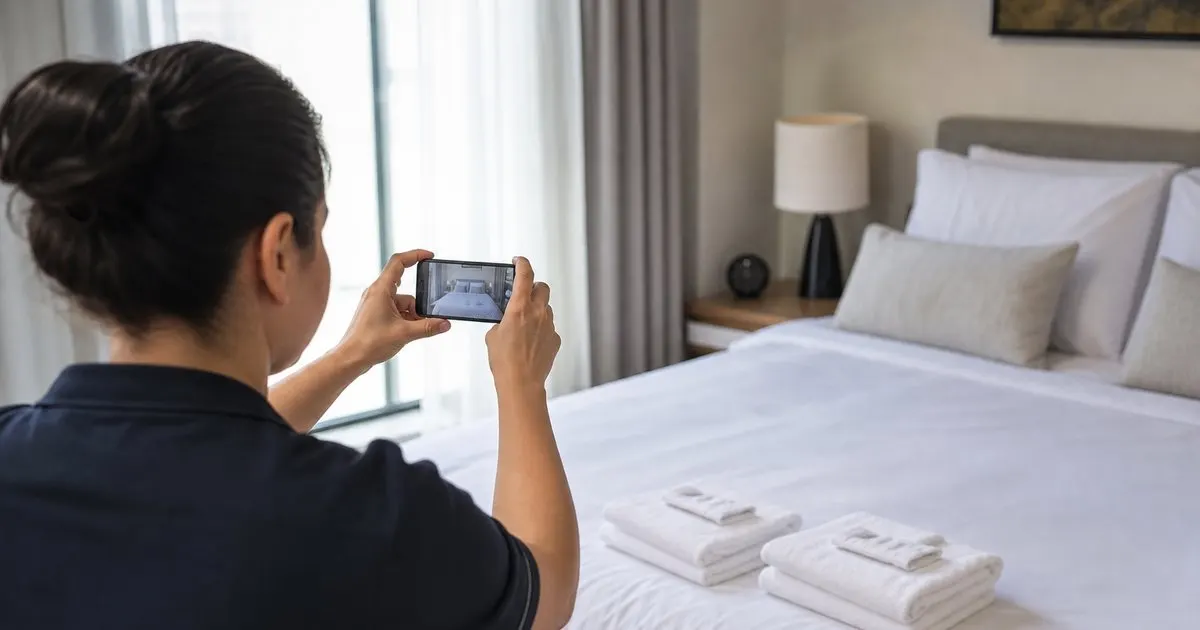
Photograph what guests judge first
The photos that matter are the ones that match the first thirty seconds of a guest's experience. That means the entryway as the door opens, each made bed from the doorway, the bathroom with the toilet lid down and towels hung, and the kitchen counters cleared with the sink empty. These are the scenes a guest sees before they decide whether the place is clean, and they are the scenes that end up in reviews and complaints. A single wide shot of each room from the door is worth more than a dozen close-ups. Related: Why a Missed Turnover Is Worse Than a Bad Review
Consistency is the whole point. Ask the cleaner to take the same photos from the same spot every time, so that a host scrolling through a week of turnovers can spot the one where the pillows are crooked or the bath mat is missing. When the angle changes every time, every photo requires interpretation. When the angle is fixed, a problem jumps out in a thumbnail. Some hosts tape a small mark on the floor where the cleaner should stand for the bed shot. It sounds fussy. It works. Related: Same Day Turnovers: Managing the Tight Window
Keep reading: Why a Missed Turnover Is Worse Than a Bad Review, Building a Cleaning Schedule From Your Bookings, Same Day Turnovers: Managing the Tight Window. See how FlipTidy helps you short-let cleaning turnover scheduler synced to bookings.
Photograph what guests complain about later
The second set of photos covers the things that generate refund requests and damage disputes: the inside of the fridge, the oven and stovetop, the inside of the microwave, under the beds, the thermostat reading, and any known trouble spot such as a stain that was already there. These are less about proving the clean and more about establishing the state of the unit at handoff. When a guest claims the fridge was filthy on arrival, a timestamped photo from a few hours before check-in is often enough to settle the conversation, and at minimum it gives the platform something concrete to weigh. Related: The Cost of a Dirty Unit at Check In
Add anything the guest could damage that you would need to prove was fine: the TV screen, glass tabletops, the couch, the condition of walls near the door. These photos rarely get looked at, which is exactly why they are worth taking. The one time you need them, they can be the difference between a claim you can support and an argument that comes down to your word against the guest's. Photos do not guarantee the platform will side with you, but without them it rarely has anything to go on. Keep the list short enough that the cleaner actually does it, typically well under twenty shots for a typical two-bedroom.
Photograph the things that get forgotten
Every unit has its own forgettable items: the coffee pod drawer, the toilet paper stock, the dishwasher emptied, the trash cans lined, the remotes placed, the lockbox closed, the patio door locked. These are the things that generate the 9 p.m. text from a guest who cannot find a clean towel. Photographing them does two things. It proves they were done, and more importantly, it forces the cleaner to look at them, which is what actually gets them done.
This is where a checklist and a photo list should be the same document. If the checklist says "restock toilet paper to four rolls," the photo of the cabinet is the checkmark. A scheduler that attaches photos to checklist items makes it obvious when a required shot is missing before a turnover is marked complete. Whether you use software or a shared album, the principle holds: the photo is the completion, not a separate chore after the completion. Related: Checklists That Keep Turnovers Consistent
Decide what you will actually do with the photos
Photos nobody reviews are just storage. Decide in advance who looks at them and when. For most hosts, a two-minute scroll through each turnover's set before check-in time is enough to catch a missed bed or an open cabinet while the cleaner is still nearby. That review window is the entire value. A photo you see at 3 p.m. can be fixed by 4 p.m. A photo you see the next day is just evidence for the apology.
Set retention rules too. Turnover photos should outlive the stay they precede by at least as long as the platform's dispute window, and it is sensible to keep them longer for units with damage history. Then, once a month, look at the pattern rather than the individual set. If the bath mat is missing in one turnover out of six, that is not a cleaner problem, that is a linen count problem, and the photos are how you find out.
- Take one wide shot per room from the doorway, in the same spot every time, so problems show up in a thumbnail.
- Photograph the fridge, oven, microwave, under beds, and known trouble spots to establish the unit's state at handoff.
- Make the photo the checklist item's completion, not a separate task, so forgettable items actually get looked at.
- Review each set before check-in time while the cleaner can still fix things, and keep photos past the platform's dispute window.

Julien Jimenez
Julien Jimenez is an independent software builder based in Paris. He designs, ships, and operates focused SaaS products for small businesses and independent professionals. Read the full author page.
Every checkout cleaned, without the group chat
Short-let cleaning turnover scheduler synced to bookings. FlipTidy is built to help you put this into practice.
Schedule turnoversMore from the FlipTidy blog
Why a Missed Turnover Is Worse Than a Bad Review

Building a Cleaning Schedule From Your Bookings
Same Day Turnovers: Managing the Tight Window
Get the FlipTidy playbook
Practical guides on turnover scheduling, straight to your inbox as we publish them. No spam, unsubscribe any time.