What is the best way to manage linen sets and laundry across several short-let units?
Linen is the quiet bottleneck in most turnovers. Here is how hosts with a handful of units keep sheets moving without buying a warehouse or losing a duvet cover every month.
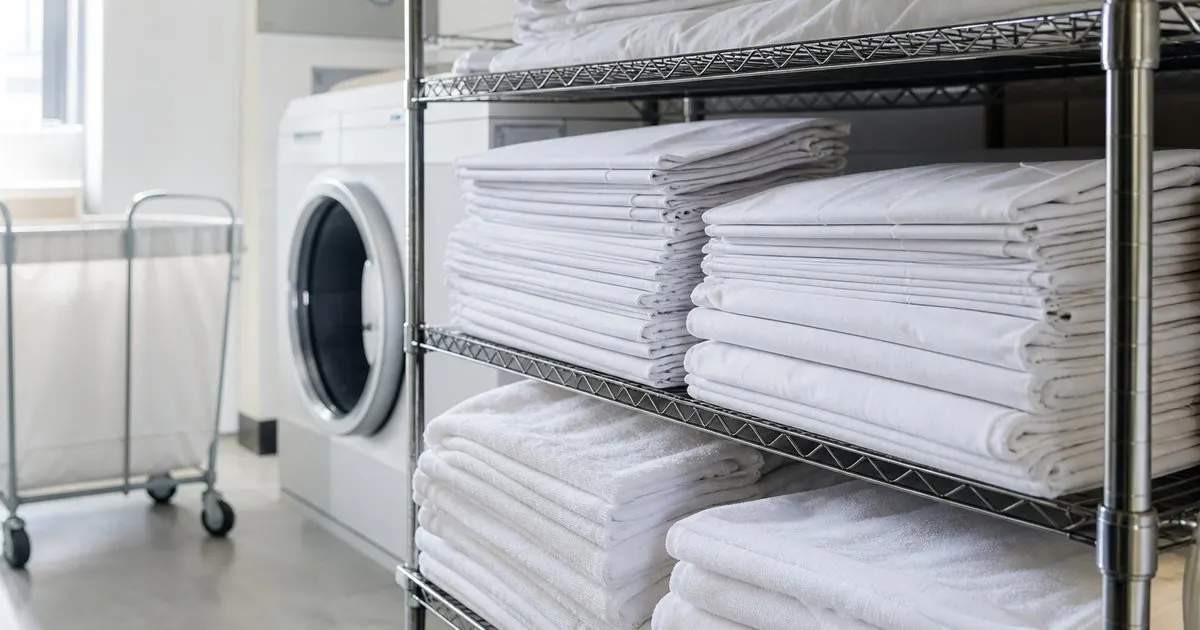
Count sets, not sheets
The unit of linen management is the complete set: everything needed to dress one bed and stock one bathroom for one stay. For a queen bed that typically means a fitted sheet, a flat sheet, a duvet cover or comforter, pillowcases, and a mattress protector, plus bath towels, hand towels, washcloths, and a bath mat for the bathroom. Thinking in sets stops the most common failure, which is having eleven fitted sheets and two duvet covers on a Saturday. Related: Scaling From One Unit to Many
The rule of thumb most hosts settle on is three sets per bed: one on the bed, one clean in the closet, and one in the wash. That third set is what lets a cleaner strip and remake a bed without waiting on a dryer. Hosts running back-to-back bookings with off-site laundry often go to four sets per bed, because a set can be gone for two or three days at a time. Count your pillows and bathrooms the same way, since a single missing bath mat can hold up a unit as effectively as a missing sheet. Related: Same Day Turnovers: Managing the Tight Window
Keep reading: Why a Missed Turnover Is Worse Than a Bad Review, Building a Cleaning Schedule From Your Bookings, Same Day Turnovers: Managing the Tight Window. See how FlipTidy helps you short-let cleaning turnover scheduler synced to bookings.
Choose where laundry happens and commit
There are really three models. In-unit laundry means the cleaner washes during the turnover, which is simple but stretches the turnover time and fails when a machine breaks. A central laundry, whether your garage or a small rented space, means clean sets travel to units in bins and dirty sets come back. A laundry service means you hand off dirty linen and receive clean linen on a schedule, usually priced by weight or by piece. Each model works. Mixing them by accident is what causes gaps. Related: Building a Cleaning Schedule From Your Bookings
The deciding factors are unit count, distance between units, and whether your cleaners drive. Two units in the same building with in-unit machines can stay in-unit for a long time. Five units spread across a city are almost always better served by a central spot or a service, because the cleaner's time is worth more than the machine time. Whatever you choose, write the rule down: who moves linen, on what day, and where the clean sets live. Cleaners should never have to guess whether there is a clean set waiting.
Design the handoff so nothing gets lost
Linen disappears in transit, not in the wash. Use labeled bins or bags per unit, with dirty and clean clearly distinguished by color or tag. A cleaner arriving with the clean bin for unit B and leaving with the dirty bin for unit B is a closed loop. A cleaner tossing dirty sheets into a car with three other units' sheets is how a king fitted sheet ends up at the studio. If you use a service, count what goes out and what comes back on a simple sheet of paper, at least for the first month, until you trust the numbers.
Give clean sets a home in each unit that guests will not find. A locked owner's closet, a high shelf in a hall closet, or a plastic tote under a bed all work. The point is that a cleaner can walk in and dress the bed in the first ten minutes without a trip to the car. If a unit is too small for storage, the clean set rides in with the cleaner, which means your schedule needs to reflect that and your cleaner needs to know which units they are carrying for on a given day.
Retire linen on a schedule, not when guests complain
Sheets and towels wear out quietly. Pilling, thinning, and a grey cast that no amount of washing fixes show up long before a hole does, and guests notice on the first night. Inspect linen at fold time, not at the bed, and pull anything that looks tired into a rag pile. Linen life is better counted in wash cycles than in calendar time; with three sets per bed, each set goes through the wash roughly once or twice a week, which typically puts replacement at a year or two for towels and longer for sheets. Build that cost into the per-night economics rather than treating it as a surprise.
Buying replacements in the same brand, size, and shade matters more than it seems, because mismatched whites look dirty even when they are clean. Keep a short note of exactly what you bought, so the reorder is a repeat rather than a search. If you track turnovers in a tool like FlipTidy, a simple recurring task to inspect linen once a month is enough to catch problems before a guest photographs a threadbare towel. Related: Why a Missed Turnover Is Worse Than a Bad Review
- Manage linen as complete sets per bed and bathroom, typically three sets per bed and four when laundry leaves the property.
- Pick one laundry model, in-unit, central, or service, and write down who moves what and when.
- Use labeled bins per unit so dirty and clean linen travel in closed loops and nothing migrates between properties.
- Inspect at fold time and retire tired linen on a schedule instead of waiting for a guest to mention it.

Julien Jimenez
Julien Jimenez is an independent software builder based in Paris. He designs, ships, and operates focused SaaS products for small businesses and independent professionals. Read the full author page.
Every checkout cleaned, without the group chat
Short-let cleaning turnover scheduler synced to bookings. FlipTidy is built to help you put this into practice.
Schedule turnoversMore from the FlipTidy blog

Why a Missed Turnover Is Worse Than a Bad Review

Building a Cleaning Schedule From Your Bookings

Same Day Turnovers: Managing the Tight Window
Get the FlipTidy playbook
Practical guides on turnover scheduling, straight to your inbox as we publish them. No spam, unsubscribe any time.